Which Tune M1 Options Are Worth Ordering From the Factory?
The ones you can't undo. That's the whole rule, and once I saw it, every configurator decision got easy.
Some options require Tune to cut the shell or build the structure differently: the cab access window, the roof vent opening, the solar port, the shore power inlet, the door style. Those happen at the factory or they happen never (or they happen later as an aftermarket project with a hole saw and a tube of sealant, which is a different kind of never for me). Everything else on the configurator is a product Tune resells, and products can be bought later, cheaper, on your own schedule.
So I paid Tune for penetrations and structure. I skipped almost everything that ships in a box. The ordering guide walks through this buy-vs-DIY logic option by option for every configurator line; this post is what happened when I applied it to a real order with my own money.
The Build Sheet
Straight from the signed purchase order:
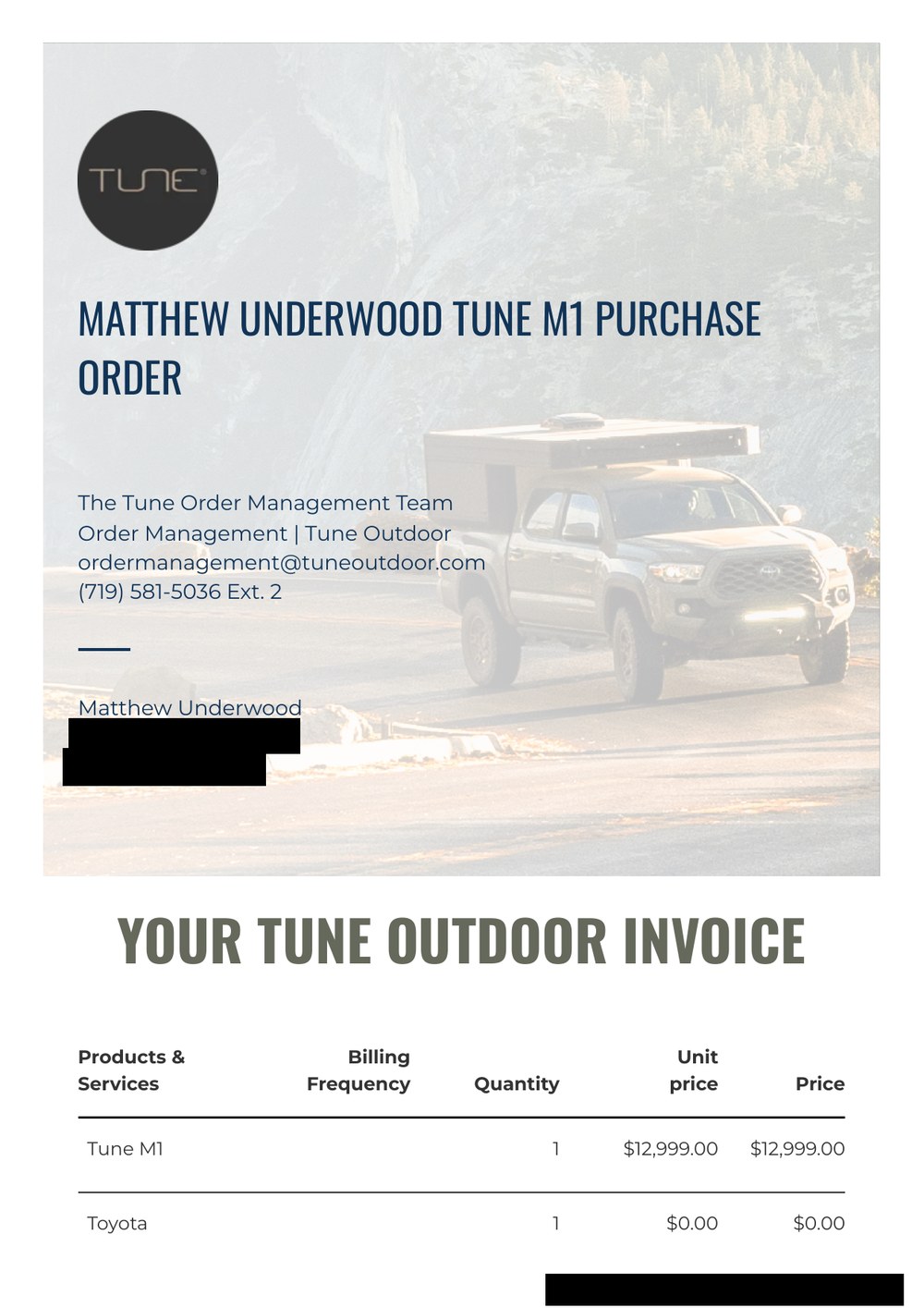
| Line item | Price |
|---|---|
| Tune M1, Tacoma (2016–2023) 6' Standard Bed platform | $12,999 |
| Color: Charcoal | $0 |
| Roof/bulkhead: White FRP (standard) | $0 |
| Aluminum awning doors, driver + passenger + rear (standard) | $0 |
| Cab access window with slider, regular size | $500 |
| MaxxAir 00-07500K roof fan, installed | $650 |
| King-size slide extender | $200 |
| Custom wiring to customer-supplied battery | $150 |
| Shore power inlet | $150 |
| Solar port | $200 |
| Heating: none | $0 |
| Subtotal | $14,849 |
$1,850 in options on a $12,999 base. For context on how small that number could have been (or how large), the configurator offered me roughly $7,000 more in options I turned down. More on those below.
The Truck This Has to Live On
Every option on that sheet was weighed, literally, against my truck. I CAT-scaled my 2023 Tacoma TRD Off-Road Access Cab before ordering: 4,400 lbs gross with a full tank, which works out to 1,200 lbs of real payload against the 5,600 GVWR. The camper, two people, water, gear, and every factory option all share that budget.
That math is why "skip the heavy stuff Tune resells" isn't just a money rule. A factory power station, a Truma furnace, and rooftop panels are all weight I'd be committing to permanently, before I've spent a single night in the thing and learned what I actually use. The aluminum shell and the holes in it are forever. The rest I want to be able to change my mind about.
What I Ordered (and Why)
Cab access window with slider ($500)
The one option Tune is explicit about: it cannot be added later. The bulkhead gets built with the window or without it, once. That asymmetry decided it for me. $500 buys pass-through access to the cab, airflow across the sleeping platform, and the ability to never wonder whether I should have ordered it. The $800 custom drop-down version exists; the regular slider covered what I wanted.
MaxxAir 00-07500K fan, installed ($650)
A roof vent means a hole in the roof, and I wanted the people who built the roof to cut it. If the seal ever leaks, there's no debate about whose work failed. I picked the 00-07500K (the remote version with the motorized lid) over the cheaper manual models because the fan placement is above the sleeping platform: closing the lid from inside a sleeping bag instead of standing on the tailgate in the rain seemed worth the difference. The accessories page covers the three MaxxAir models Tune offers and where they differ.
King-size slide extender ($200)
The sliding bracket that extends the sleeping platform over the truck cab, taking the standard queen to a king. I wrote a full breakdown of the bed extension if you want the dimensions and the honest solo-vs-couple math. One detail that aged well: I paid $200 on my April order, and Tune's price is $300 today. Configurator prices move.
Custom wiring to my own battery ($150)
This is the cheapest line on the order and the one doing the most work. Tune wires the camper's fan and lights to a connection point for a power station I supply myself. The alternative was their pre-wired Pecron package at $950. When I priced the same Pecron E1500LFP direct from the manufacturer in April, it was $469. The $150 wiring option plus a direct-bought power station beats the factory bundle by hundreds of dollars, and I get to pick the battery. The battery guide covers the current field.
Shore power inlet ($150)
A shell penetration with a weatherproof inlet, done at the factory. Cheap to say yes to now, annoying to retrofit. Campground hookups and driveway pre-trip charging both run through it.
Solar port ($200)
Same logic, roof edition. The port is the factory-sealed pass-through; the panels are just products. Tune's panel packages ran $950 to $1,750 on my configurator, and aftermarket panels cost a fraction of that to source and mount later. Port now, panels when I've lived with the power budget for a few trips. The solar guide has the panel options I'm choosing between.
What I Skipped (and Why)
The skip side of the order, with what each option cost on my April configurator and what I'm doing instead:
| Skipped option | Tune price (April 2026) | My plan instead |
|---|---|---|
| Pecron power station, pre-wired | $950 | Same unit direct from Pecron: $469 when I priced it |
| HEST Dually Wide mattress | $629 | Same price direct from HEST, with their return window |
| Solar panels (1×220W to 2×220W) | $950–$1,750 | Aftermarket panels later, $300–$500 for a pair at April prices, plus mounting |
| Truma furnace | $3,600 | Diesel heater DIY (a few hundred dollars in parts), decided after a fall of real camping |
| Glass side doors | $1,100 (pair) | Deferred. Aftermarket swap runs ~$750/side, so changing my mind costs ~$200/side extra |
Call it $7,200 of factory options replaced by roughly $1,800 of direct purchases and deferrals. Some of that gap is pure markup (the power station), some is me trading money for time and information (heat, panels, glass). The glass-door row is the honest one: deferring isn't free, and I paid for the option to change my mind.
The Truma furnace ($3,600, or $4,000 with the insulation pack)
The hardest skip on the sheet. The Truma is the best heating option for this camper and owners love it. It's also more than a quarter of the base camper price, and a diesel heater DIY install runs a few hundred dollars for the unit. I'd rather camp through a Colorado fall, learn what my real heating need is, and decide with data. The heater guide and winter camping guide cover both paths. Worst case, I'm wrong and I add heat before the snow flies; this one can be retrofitted.
The mattress
Tune sells the HEST Dually Wide for the same $629 HEST charges direct. Identical product, identical price, but buying direct gets me HEST's return window and whatever bundle promotion they're running. There was no reason to put it on the camper invoice. The mattress guide has the full comparison, including the cheaper alternatives I decided against.
The power station ($950–$1,150 bundled)
Covered above: $469 direct in April for the same unit. This was the clearest skip on the entire configurator. I have yet to find a configurator option with a wider gap between bundled price and direct price.
Solar panels ($950–$1,750)
Port yes, panels no. Panels are commodity products, the roof rails are standard, and mounting them is a wrench-and-sealant afternoon, not a factory job.
Glass doors ($550 per side, $850–$1,050 for rear barn doors)
I went standard aluminum on all three doors. Glass side doors would add $1,100 for the pair, and one question from an owner in the community group stuck with me: do they survive tight trails? Aluminum panels shrug off branches. The deciding factor was reversibility: glass awning doors can be swapped in aftermarket later (around $750 per side when I researched it), so aluminum-now keeps the option open. The rear barn door decision is the one exception; that's structural and permanent, and I chose the standard awning door for rain coverage over the tailgate.
Blackout and SunBlocker roof options ($450–$800)
Skipped both. The white FRP roof panel lets light through, and I want the camper bright. People who sleep past sunrise should take the opposite position here. This is also a bulkhead-construction decision you can't revisit, so unlike the gear skips, I made this call knowing it's permanent.
What It Cost, All-In
The number every buyer wants and no spec sheet shows:
| Line | Amount |
|---|---|
| Options subtotal | $14,849.00 |
| Reservation deposit credit | −$500.00 |
| Sales tax (Colorado, 9.15%, including deposit tax) | $1,358.68 |
| Total | $15,707.68 |
Two things I'd flag for anyone budgeting:
- Tax. Nearly $1,400 that no configurator screenshot shows you. Your rate will differ, but it won't be zero.
- The payment structure. Half at signing, half due three weeks before install. The camper isn't paid for in one hit, but the second half lands right when you're also buying a power station, a mattress, and whatever your truck needs before the install.
For what it's worth against the alternatives I cross-shopped: a comparably optioned Four Wheel Campers Project M or GFC lands in a similar range, and the comparison pages break down where the M1's extra weight and extra livability actually come from.
What I'm Second-Guessing
Honest doubts, recorded now so I can check them against reality after the install. The glass doors are the first. All-aluminum doors plus a white roof means my light comes from the top, and I won't know until I've spent rainy days inside whether I'll wish I'd paid for side glass. If I'm wrong, the aftermarket swap costs about $200 more per side than ordering glass up front would have. That's the price of deferring the decision, and I knew it when I signed.
Heating is the second. Skipping the Truma saved $3,600 against a DIY path I haven't built yet. If the diesel heater project stalls past October, I'll be cold and annoyed at April me.
The king-size slide extender is the third, and it's the line I flagged up top. I camp solo most of the time, and I paid $200 to turn a queen into a king I might rarely unfold. It was cheap, and I can leave it retracted, but if it becomes the setup step I do out of habit and never actually use, this is the option I'll point to.
Insulation is the one I already suspect I got wrong. I skipped it to hold down weight and cost, and a Colorado fall is going to test that fast. It stacks on top of the heating skip: no furnace and no insulation is two bets on the same cold night. Tune builds the insulation to fit the shell, and matching that with a DIY job later is the kind of retrofit I'd rather avoid. There's a real chance I buy the insulation pack before I ever build the heater.
And one that's pure vanity: the black FRP looks sick. I chose white on purpose, for the light it lets inside and a cooler roof in the sun, and I stand by that reasoning. I still catch myself looking at black-roof builds and wishing mine were one. Function won the order. My eyes didn't get the memo.
Everything else on the sheet I'd sign again today without blinking.
This post is the "before" photo, published the week the camper goes on. The install-day account is the next post, and later this year comes the one comparing what I planned here against what I actually use. If that slide extender turns out to be the thing gathering dust, you'll read it here first.
Run your own order math before you sign
My build sheet solves my truck and my camping. Yours has different payload, different winters, different sleepers. Run your configuration through the payload calculator to see what your options weigh before Tune builds them into your shell, and read the ordering guide for the option-by-option buy-vs-DIY breakdown this order was built on.